
TL;DR

Get workout gear delivered free with Prime
- Fast, free delivery on millions of items
- Prime Video, Amazon Music and more included
- Member-only deals all year
In a 16-week supervised study, 69.6% of participants assigned to high-intensity walking improved by one category on the SHARE-FI frailty measure, compared with 46.4% in the casual-speed group. Both groups showed improvement, but the results do not establish that this intensity is safe or suitable for every older adult.
A 16-week supervised walking study found that a larger share of prefrail and frail participants improved by one category on a frailty measure when assigned to high-intensity walking than when assigned to casual-paced walking. The finding suggests walking intensity may matter for this group, but it does not show that brisk walking is appropriate for every older adult or that it prevents frailty in all people.
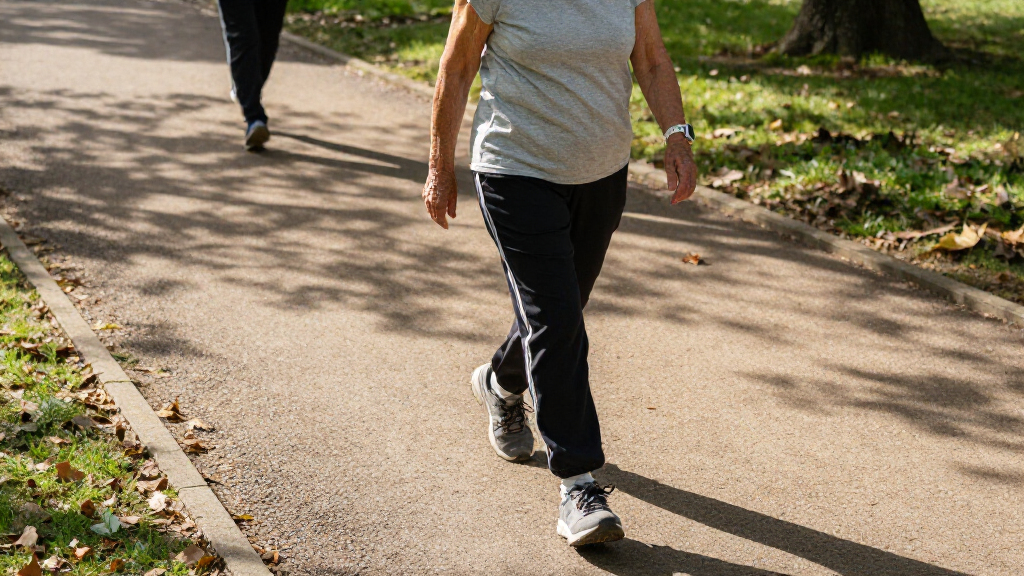
Participants completed three supervised walking sessions a week for 16 weeks. The high-intensity group aimed to reach about 70% of maximum heart rate. The comparison group walked at self-selected speeds below 60% of maximum heart rate, according to the Fit&Well report.
At the end of the study, 69.6% of the high-intensity group had improved by one category on the Survey of Health, Ageing and Retirement in Europe Frailty Index, known as SHARE-FI. In the casual-speed group, 46.4% improved by one category. The source reports that both approaches were associated with improvement on this measure; the figures do not mean every participant became less frail.
SHARE-FI covers fatigue, appetite, grip strength, functional ability and how often someone completes low- or moderate-energy daily tasks. Functional ability includes walking 100 meters or climbing a flight of stairs without resting. The study’s reported outcome is a change in this frailty classification, not a demonstration that one walking pace improves every aspect of health.
Why Walking Intensity May Matter
The results offer a practical comparison for older adults and clinicians considering activity as part of healthy aging: both walking groups had participants who improved, while the proportion improving by one SHARE-FI category was higher in the group assigned a faster effort. This points to exercise intensity as a factor worth studying, rather than suggesting that only strenuous activity can help.
The supervised setting matters. Participants were guided through the program, and the report does not establish that an unsupervised plan at 70% of maximum heart rate would produce the same results. For people who are prefrail, frail, or managing health conditions, the appropriate pace can vary. Study findings are not individual exercise advice; people unsure about starting or increasing activity should discuss it with a health professional.
Products Worth Considering

BowFlex Results Series SelectTech Adjustable Dumbbells (Pair)

Bowflex SelectTech 840 Adjustable Kettlebell

Levoit Core 400S-P Smart Air Purifier for Large Rooms
As an affiliate, we earn on qualifying purchases.
How the Study Measured Frailty
The study focused on whether there was an optimal walking intensity for prefrail and frail adults, according to the report. It compared a higher-intensity target with self-selected walking below 60% of maximum heart rate, using SHARE-FI to assess changes over 16 weeks.
Heart-rate targets provide one way to describe exercise effort, but they are not the only way to judge whether a pace is manageable. Fit&Well’s report mentions interval-style walking as a possible way to alternate brisk and easier periods, but it does not say that the study tested that specific approach. Its results apply to the program and participants described, not automatically to every walking routine or older population.
“High-intensity walking can reverse frailty more effectively than casual-speed walking due to increased physiologic stimuli during more intensive activity.”
— The study authors, as quoted in the Fit&Well report
Limits of the Reported Findings
The supplied report does not provide the study’s full citation, participant count, age range, health details, or information on how participants were assigned to each group. It also does not give results beyond the reported change in SHARE-FI category, so the size and duration of any broader health effects cannot be established from this material.
It remains unclear whether the difference between the groups would persist over a longer period, whether it applies to people outside the study population, or what intensity is safe for an individual with particular health conditions. The reported percentages describe participants improving by one category; they do not show that all participants benefited or that walking alone can reverse frailty for everyone.
What Readers Should Watch For
The next useful information would be the full study publication, including its methods, participant characteristics, statistical analysis and any follow-up after the 16-week program. Those details would help readers judge how broadly the results apply and how large the difference between walking groups may be.
For now, the study supports a measured takeaway: higher-intensity walking was associated with a greater share of one-category improvements in this supervised program, while improvement was also reported in the casual-speed group. Anyone considering a faster walking routine should build activity gradually and seek professional guidance if they have existing health conditions, mobility concerns or uncertainty about their safe effort level.
Key Questions
What did the study find?
After 16 weeks, 69.6% of the high-intensity group improved by one SHARE-FI category, compared with 46.4% of the casual-speed group. The reported outcome was a change on this frailty measure.
How fast did the high-intensity group walk?
The group aimed for an effort that raised heart rate to about 70% of maximum heart rate. The comparison group chose their own pace below 60% of maximum heart rate.
Does this prove brisk walking is right for every older adult?
No. The results came from a supervised program for prefrail and frail adults and do not establish a safe or suitable intensity for every person. People with health conditions or mobility concerns should seek professional guidance before increasing exercise intensity.
What does SHARE-FI measure?
SHARE-FI assesses fatigue, appetite, grip strength, functional ability and participation in low- or moderate-energy daily tasks. The reported improvement was a one-category change on that index.
Source: fitandwell.com