TL;DR

Get workout gear delivered free with Prime
- Fast, free delivery on millions of items
- Prime Video, Amazon Music and more included
- Member-only deals all year
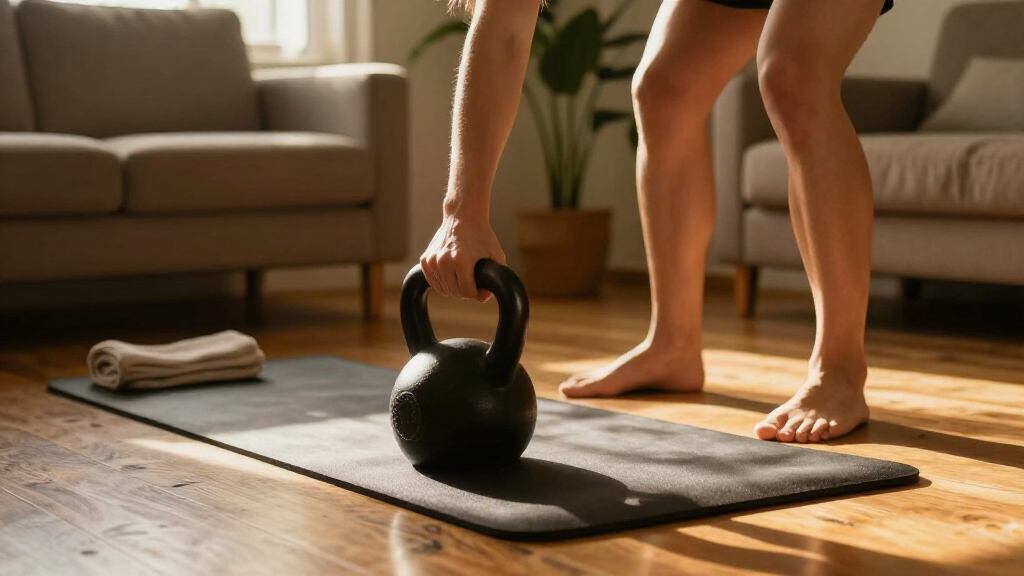
Fit&Well has published a 10-minute, three-exercise kettlebell routine intended to work the core at home. Certified kettlebell specialist Faith Ellis recommends a half-kneeling halo, a single-arm suitcase carry and a dead bug with a pullover, while advising beginners to prioritize control and form over heavier weights.
Fit&Well has published a 10-minute kettlebell workout built around three exercises that, according to certified kettlebell specialist Faith Ellis, challenge the core’s ability to stabilize the body. The routine is designed for home use and includes suggested sets, repetitions and starting weights, though the report does not describe it as a clinically tested program or provide evidence that it will produce a specific strength result.
The workout pairs a half-kneeling kettlebell halo with a single-arm suitcase carry and a kettlebell dead bug variation. Fit&Well recommends three sets of each movement. The halo calls for four circles in each direction on each side; the carry is performed for 30 seconds per side; and the dead bug is performed for six to eight repetitions per side. The source does not specify rest intervals or explain exactly how the exercises fit into a 10-minute schedule.
For the half-kneeling halo, the exerciser holds a kettlebell by its horns at chest height while kneeling on one knee, then circles it around the head without letting the hips turn. Fit&Well suggests beginning with a 10- to 18-pound (4- to 8-kilogram) bell. The carry involves walking at a controlled pace with the bell held at one side; its suggested starting range is 18 to 26 pounds (8 to 12 kilograms).
The final exercise is a dead bug with a pullover: lying on the back, the participant holds a light bell above the chest, keeps the knees bent over the hips and lowers one leg while moving the bell behind the head. The report suggests a 10- to 18-pound (4- to 8-kilogram) weight. Ellis advises starting light to medium, keeping a neutral spine and controlling breathing, then adding weight, repetitions or slower repetitions only after the movement feels easy with good form.
A Short Routine Built Around Stability
The routine offers readers a compact home workout that uses one piece of equipment and includes both standing and floor-based movements. Its emphasis is not simply on repeated trunk flexion: the exercises ask the body to stay steady while a weight moves around or away from it. That may make the sequence useful to people looking for a brief way to practice controlled movement, although the source does not provide a measured outcome or compare it with other core-training plans.
For beginners, the practical value lies partly in the specific starting guidance. Suggested weight ranges and repetition counts give readers a place to begin, while Ellis’s advice to increase the load gradually discourages treating heavier weight as the only measure of progress. The workout still requires enough space to walk safely and a kettlebell that the user can control.
The article’s claims about building deep core strength are attributed to Ellis and represent expert guidance, not a reported trial of this exact 10-minute sequence. Individual ability, technique and consistency can affect how challenging the movements feel; readers should not assume that a short routine guarantees a particular result.
Products Worth Considering

Bowflex SelectTech 840 Adjustable Kettlebell

BowFlex Results Series SelectTech Adjustable Dumbbells (Pair)

Garmin Forerunner 55 GPS Running Smartwatch, Black
As an affiliate, we earn on qualifying purchases.
How Ellis Describes Kettlebell Training
In the Fit&Well report, Ellis describes kettlebells as versatile tools for strength, mobility and cardiovascular training. She says kettlebell movements can ask the core to stabilize and transmit force, rather than relying only on bending the spine. In her account, single-arm and offset exercises also challenge the trunk to resist rotation and sideways bending.
The three selected movements reflect that approach: the halo moves the load around the head, the suitcase carry places it on one side, and the dead bug combines an arm movement with alternating leg extension. Fit&Well presents them as beginner-friendly options, but the article’s suggested weights are starting points rather than requirements. It also recommends adding 4 to 8 pounds (2 to 4 kilograms), or changing repetitions or tempo, only when a set can be performed comfortably with sound form.
“A single kettlebell trains strength, mobility and cardiovascular endurance simultaneously, making it ideal for efficient workouts.”
— Faith Ellis, certified kettlebell specialist and founder of The KettleBelle, as quoted by Fit&Well
Timing and Training Evidence Not Specified
The source material does not identify the report’s publication date, explain whether the three sets of each exercise include rest periods, or show a timed breakdown confirming how the full prescription fits into 10 minutes. It also does not cite research testing this precise sequence or quantify changes in strength, fitness or injury risk. The article’s expected benefits should therefore be understood as expert guidance, not a guarantee.
The report does not give modifications for people with injuries, balance limitations or other health concerns. Readers who are new to resistance training or have a pre-existing condition may want to seek advice from a qualified health professional or trainer. The suggested loads may not suit every person, and the movements should be stopped if they cause pain or cannot be performed with control.
Start Light and Progress Gradually
Fit&Well’s guidance is to begin with a light-to-medium kettlebell, practice the movements with control and keep the spine neutral, then progress only when the work feels manageable with good form. Ellis suggests adding 4 to 8 pounds (2 to 4 kilograms), increasing repetitions or slowing the pace as options. The report does not announce a follow-up, testing plan or further development; readers using the routine can adjust it to their ability and seek qualified guidance if unsure about technique or loading.
Key Questions
What exercises are in the workout?
The three movements are a half-kneeling kettlebell halo, a single-arm suitcase carry and a kettlebell dead bug with a pullover.
How many sets and repetitions does Fit&Well recommend?
The report lists three sets of each movement: four halo circles in each direction per side, a 30-second carry on each side, and six to eight dead bug repetitions per side. It does not specify rest periods or a detailed minute-by-minute schedule.
What weight should a beginner use?
Fit&Well suggests 10 to 18 pounds (4 to 8 kilograms) for the halo and dead bug, and 18 to 26 pounds (8 to 12 kilograms) for the carry. These are suggested starting ranges, not a requirement; Ellis advises choosing a load that allows controlled form.
Does the routine guarantee stronger core muscles?
No. The report presents Ellis’s explanation of how the movements challenge stability, but does not cite a study of this exact workout or promise a specific outcome. Results can vary with a person’s ability, technique and training consistency.
Source: fitandwell.com