TL;DR

Get workout gear delivered free with Prime
- Fast, free delivery on millions of items
- Prime Video, Amazon Music and more included
- Member-only deals all year
Fit&Well reports that personal trainer Chris Browning recommends shoulder presses, squats, planks, rows and glute bridges for beginners training at home. The routine uses body weight and light dumbbells, with suggested starting sets and repetitions; individual needs and safe technique still matter.
Fit&Well has outlined five exercises for people beginning strength training at home, based on recommendations from personal trainer Chris Browning. The routine combines a shoulder press, bodyweight squat, plank, dumbbell row and glute bridge, using basic equipment and accessible movements to work different parts of the body.
Browning, whom Fit&Well describes as having more than 20 years of experience creating home workouts, said he chose the movements because they are relatively simple to learn, can be progressed and collectively target major muscle groups. The article suggests starting with a pair of fairly light dumbbells for the press and row; the squat, plank and bridge use body weight.
Fit&Well gives a starting recommendation of two to three sets for each movement. It lists 10 to 15 repetitions for the shoulder press, squat, row on each side and glute bridge. For the plank, it suggests holding for 30 to 60 seconds. Browning advises beginners to stop the hold when the position becomes challenging or uncomfortable, or when they can no longer maintain good form.
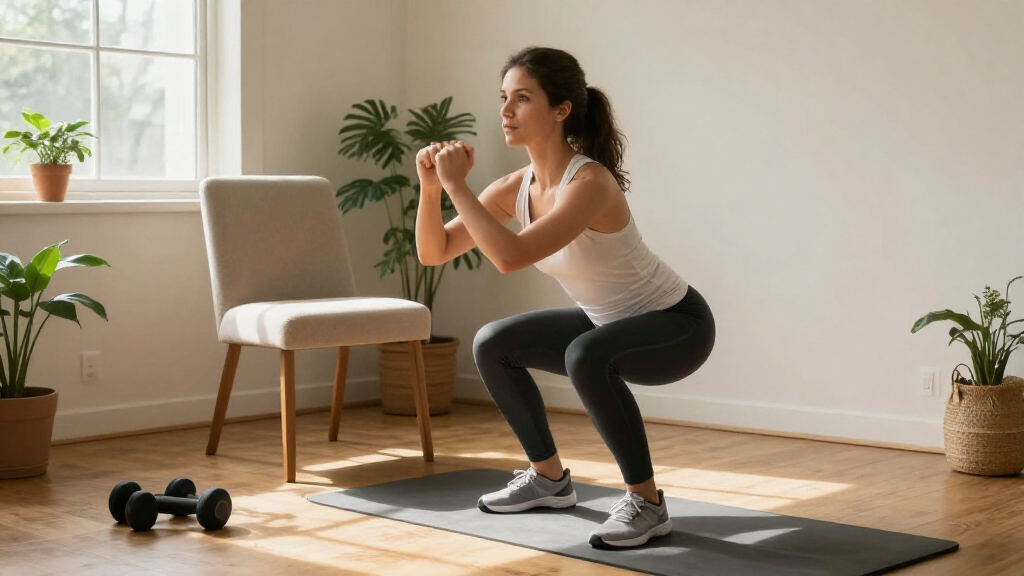
The exercise instructions emphasize controlled movement and alignment. For example, the squat should be performed only as low as comfortable, with knees tracking in line with the toes. The row is done with a flat back and braced core, while the bridge involves lifting the hips until the body forms a line from chest to knees. Fit&Well says people may consider increasing dumbbell weight after practicing for a few weeks if the movements begin to feel easy.
A Simple Starting Point at Home
The recommendations offer beginners a structured starting routine without requiring gym machines or a large equipment setup. The five movements cover pressing, pulling, lower-body work and trunk stability, giving readers a practical way to organize a home session rather than choosing exercises at random.
The article’s guidance is a general template, not a personalized training plan. Repetitions and hold times may not suit every person, and the source does not establish that this exact combination is best for all beginners. People should prioritize comfortable range of motion and controlled form over completing a prescribed number, particularly when learning unfamiliar movements.
Products Worth Considering

BowFlex Results Series SelectTech 552 Adjustable Dumbbell

BowFlex Results Series SelectTech Dumbbells

BowFlex SelectTech 840 Adjustable Kettlebell
As an affiliate, we earn on qualifying purchases.
How the Five Moves Fit Together
The five exercises use a mix of body weight and light dumbbells. The shoulder press trains an overhead pushing movement, while the row provides a pulling movement. Squats and glute bridges work the lower body in different positions, and the plank challenges the ability to keep the torso steady.
Fit&Well presents the routine as a beginner option and describes progression as something to consider after several weeks of practice. Its supplied instructions do not provide a weekly schedule, rest intervals, a warm-up plan or a method for choosing a specific dumbbell weight. Those details should not be inferred from the exercise list.
Limits of the General Routine
The supplied report does not specify a publication date or provide research comparing this routine with other beginner programs. It also does not give individualized guidance on training frequency, rest periods, load selection or adapting exercises for injuries, medical conditions or mobility limitations. Browning’s recommendations are attributed expert guidance, not evidence that every reader should use the same sets and repetitions.
The source does not describe how to assess technique or when to move to heavier weights beyond suggesting an increase if the exercises feel easy after a few weeks. Beginners should not treat discomfort during a plank as a target to push through, and the article’s general advice is not a substitute for professional guidance where health concerns affect exercise.
Progress Only When Form Holds
The next step in the source’s suggested approach is to practice the movements with light dumbbells and controlled technique, then reassess how challenging they feel after a few weeks. If a movement becomes easy while remaining comfortable and well controlled, the report suggests increasing the weight. It does not prescribe a specific increase or timetable.
People new to exercise can begin within the listed ranges and adjust based on their ability to maintain form. Anyone with a pre-existing condition, injury or uncertainty about safe movement should seek advice from a qualified health or fitness professional before starting or changing a routine.
Key Questions
Which five exercises does the report recommend?
Fit&Well’s list includes a dumbbell shoulder press, bodyweight squat, plank, dumbbell row and glute bridge, drawing on advice from trainer Chris Browning.
What equipment is needed?
The press and row use a pair of fairly light dumbbells. The squat, plank and glute bridge are bodyweight exercises, according to the supplied instructions.
How many sets and repetitions are suggested?
The report suggests two to three sets. It lists 10 to 15 repetitions for the press, squat, row on each side and bridge, and a 30-to-60-second plank hold. Browning says to end the plank when it becomes uncomfortable or proper form cannot be maintained.
When should a beginner use heavier dumbbells?
Fit&Well says to consider increasing the weight after practicing for a few weeks, if the exercises start to feel easy. The report does not give a specific weight increase or individualized progression plan.
Source: rss