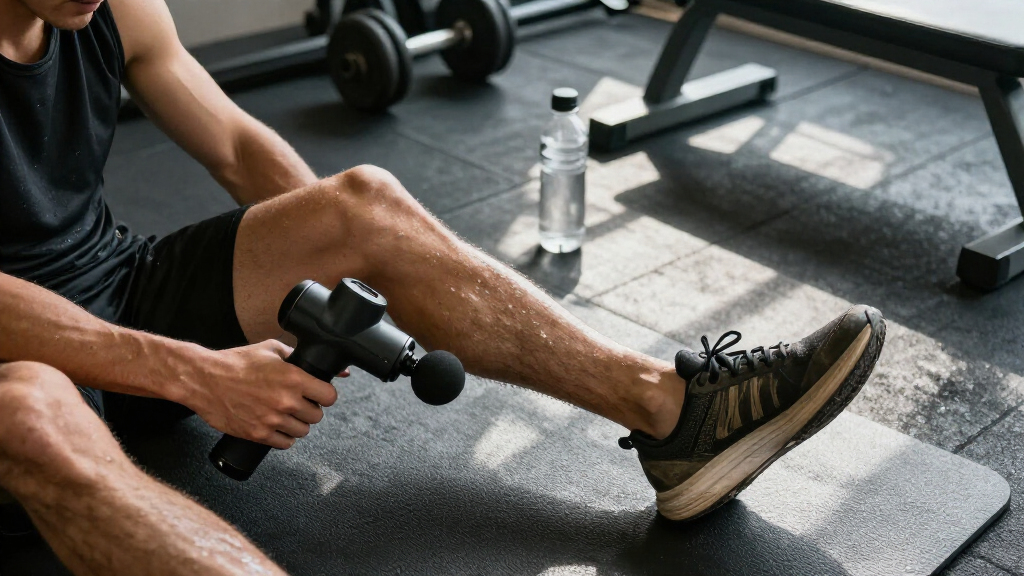

Use a percussive massage gun to apply brief, controlled pressure to large muscle groups such as the thighs, calves, and upper back. This beginner guide explains how to prepare the device, choose an attachment and speed, move it across a muscle, and stop if you feel pain or numbness. A typical session takes 5-10 minutes.

Get workout gear delivered free with Prime
- Fast, free delivery on millions of items
- Prime Video, Amazon Music and more included
- Member-only deals all year

TOLOCO Percussion Massage Gun with 10 Massage Heads
- ✔ Type: Cordless percussion massage gun
- ✔ Stroke length: 12 mm
- ✔ Maximum speed: 3,200 rpm

AERLANG Massage Gun with Heated Head, 20 Speeds and LCD Display
- ✔ Massage heads: 6, including a heated head
- ✔ Speed settings: 20
- ✔ Motor speed: 1,400–3,200 rpm

Therabody Theragun Relief Massage Gun, 3-Speed, Navy
- ✔ Speeds: 3
- ✔ Control: One-button
- ✔ Attachments: Dampener, Standard Ball, Thumb
Difficulty: Beginner | Time: 5-10 minutes per session
What You’ll Need
Tools & Materials:
- Percussive massage gun with a charged battery
- The device’s user manual
- A chair or stable place to sit, if treating your legs
Knowledge:
- Basic awareness of which areas are muscles and which are joints or bones
- Ability to recognize pain, tingling, numbness, or unusual bruising
Read the device manual for its controls, attachment instructions, and time limits. If you have a medical condition, recent injury or surgery, reduced sensation, or take medicine that affects bleeding, ask a qualified health professional whether massage gun use is suitable for you. Do not use the gun to diagnose or treat an injury.
TOLOCO Percussion Massage Gun with 10 Massage Heads
For shoppers who want one device to cover a range of muscle areas and massage preferences, TOLOCO is the most balanced pick here. Its 12 mm stroke and speeds up to 3,200 rpm give it a stated performance range that is more clearly aimed at adaptable percussion than the gentler Therabody Relief. Ten removable heads offer the widest selection in this lineup, which can help tailor contact to different areas, though buyers should expect to spend time deciding which head to use.The LED touch screen and multiple speed settings provide more adjustment than Therabody’s one-button, three-speed approach. Compared with AERLANG, TOLOCO skips the heated head and applied-pressure display, but keeps the setup more straightforward: there is no separate heating attachment to charge. Its motor is rated at 40–50 dB, and the cordless battery is listed for up to six hours depending on speed. That runtime is not fixed across settings, and the charging plug is not included, so buyers need a compatible USB power adapter. TOLOCO makes the most sense when versatility matters more than heat or a narrowly focused routine.
Pros:
- Ten removable heads provide the broadest attachment selection in this comparison.
- 12 mm stroke and speeds up to 3,200 rpm support varied percussion preferences.
- LED touch screen and multiple speed settings allow on-device adjustment.
- Cordless design and stated battery life of up to six hours suit use away from an outlet.
Cons:
- Charging plug is not included, so a compatible adapter is needed.
- Battery life depends on the selected speed and may fall short of the stated maximum.
- Ten heads may be more choice than buyers who prefer a simple setup need.
Best for: Buyers who want a versatile cordless massage gun with many attachment choices and adjustable intensity for different muscle areas.
Not ideal for: Shoppers who want a heated attachment, applied-pressure feedback, or a charging plug included in the box.
Bottom line: Choose TOLOCO for the most adaptable general-purpose setup in this group, provided you are comfortable supplying your own charging plug.
“Choose TOLOCO for the most adaptable general-purpose setup in this group, provided you are comfortable supplying your own charging plug.”
AERLANG Massage Gun with Heated Head, 20 Speeds and LCD Display
AERLANG is the feature-led alternative for buyers who want to adjust their session in finer increments. With 20 speed settings, it offers more steps between low and high than TOLOCO’s described multiple-speed controls or Therabody’s three fixed speeds. Its LCD also displays applied pressure, adding a cue for users who want to pay attention to how firmly they press. That can make the device feel more informative, although the display does not replace choosing a comfortable level.The standout addition is a heated head with three temperature settings up to 131°F. This gives AERLANG a different role from TOLOCO’s broad head assortment and Therabody’s simpler, gentler approach. There are six heads in total, including the heated one, and a carrying case supports storage and travel. The tradeoff is extra setup: the heating head charges separately, and the stated initial charge times are approximately six hours for the body and two hours for the head. Buyers who do not expect to use heat may find those added steps and the more involved feature set unnecessary. AERLANG fits best when pressure feedback and temperature choice are central to the buying decision.
Pros:
- Twenty speed settings provide more adjustment steps than the three-speed Therabody model.
- LCD displays applied pressure for added feedback during use.
- Heated head has three temperature settings up to 131°F.
- Six heads and a carrying case support varied use and storage.
Cons:
- The heating head must be charged separately from the massage gun body.
- Initial charging instructions call for about six hours for the body and two hours for the heating head.
- Its extra features may add setup complexity for buyers who only want basic percussion.
Best for: Buyers who want a wide range of speed adjustments, an applied-pressure display, and the option to use a heated attachment.
Not ideal for: People who prefer a simple grab-and-go routine, do not want to charge an attachment separately, or will not use the heat feature.
Bottom line: Pick AERLANG if heat and guided pressure feedback matter enough to justify separate attachment charging and a more involved setup.
“Pick AERLANG if heat and guided pressure feedback matter enough to justify separate attachment charging and a more involved setup.”
Therabody Theragun Relief Massage Gun, 3-Speed, Navy
Therabody Theragun Relief is the easiest choice to understand in this comparison: it is designed for gentle, soothing percussion, with three speeds and one-button control. That focused approach suits buyers who would rather start with a small number of settings than work through TOLOCO’s 10 heads or AERLANG’s 20 speeds. The simpler control scheme is also its limitation. Shoppers who want a stronger-feeling massage or more granular adjustment should look first at TOLOCO or AERLANG.Its three attachments are assigned different purposes: the Dampener for sensitive muscles, the Standard Ball for general tension, and the Thumb for lower back or trigger points. That is a smaller assortment than TOLOCO provides, but the defined roles may make selection less daunting. The patented triangle grip is intended to help users reach areas without assistance, giving it a practical distinction from the other two models, whose supplied descriptions do not highlight a comparable grip. The lightweight design and whisper-quiet motor also suit convenient daily use. Buyers should still choose based on the stated gentle focus, and note that the product is described as an FDA-registered medical device. Therabody makes most sense when simplicity, reach, and a milder approach matter more than power range or feature count.
Pros:
- Three speeds and one-button control keep operation straightforward.
- Three attachments have distinct stated roles for sensitive muscles, general tension, and lower back or trigger points.
- Triangle grip is designed to help users reach areas without assistance.
- Lightweight design and whisper-quiet motor support convenient routine use.
Cons:
- Gentle massage level may not suit buyers seeking stronger percussion.
- Three speeds offer less adjustment than the 20-speed AERLANG and the broader settings described for TOLOCO.
- It has three attachments, fewer than either competing model.
Best for: Buyers seeking a lightweight, quieter massage gun for gentle daily use, with a grip intended to help reach areas independently.
Not ideal for: People who want strong percussion, many speed steps, a heated head, or a large number of attachments.
Bottom line: Choose Therabody Relief for uncomplicated, gentle daily percussion and easier reach, rather than maximum intensity or customization.
“Choose Therabody Relief for uncomplicated, gentle daily percussion and easier reach, rather than maximum intensity or customization.”
As an Amazon Associate we earn from qualifying purchases.
Before You Start
Use the massage gun only on intact skin over a large muscle. Avoid the head, face, front of the neck, spine, joints, bones, and areas with swelling, bruising, wounds, or a rash. Do not use it on a blood clot or suspected clot, or on an area with unexplained pain. Keep the device moving; pressing hard or holding it in one place can irritate tissue. Stop immediately if you feel sharp pain, tingling, numbness, dizziness, or worsening discomfort.
Step-by-Step Instructions
Step 1: Choose a muscle and check the area
Select one large muscle group, such as a thigh or calf. Sit or stand in a stable position and relax the muscle. Check the skin for cuts, bruises, swelling, or irritation, and identify nearby joints and bones so you can avoid them.
Tip:If you cannot tell whether a sore spot is muscle or bone, skip that spot.
Check: You can reach the target muscle comfortably, and the skin is intact with no concerning changes.
Step 2: Fit a suitable attachment
Switch the device off before changing attachments. Fit the broad, soft attachment recommended by the manual for general muscle use, and check that it is seated securely. Use a specialized attachment only if the manufacturer describes its intended use and you can keep it on a large muscle without contacting bone.
Tip:Attachment names and uses vary by model. Follow your manual instead of assuming a pointed attachment is suitable for a tender area.
Check: The attachment is secure, and you know how to turn the device on and off.
Step 3: Start at the lowest speed
Place the attachment lightly against the muscle before turning the device on, if the manual recommends this method. Start at the lowest speed and let the device’s weight provide the contact. Do not force it into your body.
Tip:If your device starts with a jolt or the sensation feels uncomfortable, switch it off, reposition, and restart at a lower setting if available.
Check: The sensation feels mild and tolerable, without sharp pain, tingling, or numbness.
Step 4: Move slowly across the muscle
Glide the device slowly along the muscle, covering a comfortable area with smooth passes. Keep it moving and use light pressure. Avoid sliding over joints, bones, the spine, or any area that causes pain. Treat one side at a time so you can notice how the sensation changes.
Tip:Do not use the gun over the front or sides of the neck, or over the lower back where the device may strike bone or sensitive structures.
Check: The device travels over the muscle without lingering in one spot, and the contact remains comfortable.
Step 5: Limit time on each muscle
Spend about 30-60 seconds on a small muscle area, then move on. Keep the full session brief, generally around 5-10 minutes, and follow any shorter limit in your manual. Do not keep treating a spot to try to remove soreness.
Tip:More time or stronger pressure does not guarantee a better result and may leave the area tender or bruised.
Check: You have covered the chosen muscle briefly and evenly without prolonged pressure or a rising level of discomfort.
Step 6: Switch off and check your response
Turn the device off before setting it down or removing the attachment. Check the treated skin and notice how the area feels as you move normally. Stop using the device if you see bruising or swelling, or if soreness, tingling, numbness, or pain increases.
Tip:Mild temporary warmth can occur. Persistent pain, new weakness, or other unusual symptoms call for medical advice.
Check: The skin is not bruised or swollen, and normal movement does not cause new or worsening symptoms.
Common Mistakes to Avoid
- Pressing hard to make the massage feel more effective. — Use light contact and let the device’s weight do the work. Lower the speed or stop if the sensation becomes painful.
- Holding the device still on a tender point. — Keep it moving over the muscle. Skip a spot that remains painful rather than applying more pressure or time.
- Using the gun on bones, joints, or the front of the neck. — Treat only large muscles and avoid the areas listed in the manual and this guide.
- Treating bruising or injury as ordinary muscle soreness. — Do not use the gun on swollen, bruised, injured, or unexplained painful areas. Seek qualified advice when symptoms are concerning.
Troubleshooting
Problem: The massage feels sharp or painful.
Solution: Turn the device off, remove it from the area, and check your position. Do not resume on a painful spot. If pain persists or worsens, seek medical advice.
Problem: The device causes tingling or numbness.
Solution: Stop immediately and do not treat that area again. Get medical advice if the sensation does not quickly resolve or returns.
Problem: The skin becomes bruised or swollen after use.
Solution: Stop using the device on that area. Avoid further pressure and ask a health professional for guidance, especially if swelling or bruising is significant or worsening.
Problem: The attachment feels loose or the device stalls.
Solution: Switch the device off, then check the attachment and battery according to the manual. Do not use a damaged device or force an attachment into place.
What Success Looks Like
A successful session is brief and comfortable: you treated a large muscle with light pressure, kept the device moving, avoided joints and sensitive areas, and stopped without new pain, numbness, swelling, or bruising. A massage gun may temporarily change how tight an area feels, but it does not confirm that an injury is healed.
Next Steps
Switch off the device, clean the attachment as directed in the manual, and store it safely. Pay attention to how the area feels over the next several hours. Leave the muscle alone if it becomes sore or irritated. If pain is persistent, severe, or linked to an injury, consult a qualified health professional before using the device again.
Frequently Asked Questions
How long should I use a massage gun on one muscle?
Start with about 30-60 seconds on a small area and keep the session brief. Follow the device manual if it gives a shorter limit, and stop sooner if discomfort develops.
Should a massage gun hurt?
No. The sensation should be tolerable and controlled. Sharp pain, tingling, numbness, or increasing discomfort means you should stop.
Can I use a massage gun on my neck or spine?
Avoid the front and sides of the neck and do not run the device over the spine. If you want to treat a muscle near those areas, ask a qualified professional to show you a safe location for your model.
Can I use it on sore muscles after exercise?
You can use light, brief passes on intact, uninjured muscle if the sensation is comfortable. Do not use the device on bruising, swelling, or sharp pain, and stop if soreness worsens.