TL;DR

Get workout gear delivered free with Prime
- Fast, free delivery on millions of items
- Prime Video, Amazon Music and more included
- Member-only deals all year
A study reported by ScienceDaily found that older adults whose diets more closely matched the Mediterranean pattern had higher blood levels of two mitochondrial microproteins, humanin and SHMOOSE, and lower indicators of oxidative stress. The findings suggest a possible biological link, but do not establish that the diet caused the changes or that the proteins prevent heart or brain disease.
Older adults whose eating habits more closely followed the Mediterranean diet had higher blood levels of two small proteins produced by mitochondria, according to a study from the USC Leonard Davis School of Gerontology. The researchers also found lower indicators of oxidative stress in this group, suggesting a possible cellular pathway behind the diet’s established health associations, but the reported findings do not prove the diet caused the differences or that the proteins prevent disease.
The study examined blood samples from older adults whose adherence to the Mediterranean diet varied. Those with eating patterns that most closely matched it had significantly higher concentrations of humanin and SHMOOSE, mitochondrial microproteins that researchers have previously investigated for possible roles in cardiovascular and brain health. The report does not provide the study’s sample size, numerical effect estimates, or follow-up period.
The researchers also observed lower indicators of oxidative stress among people with closer adherence. Oxidative stress occurs when reactive oxygen species outpace the body’s protective defenses and can damage cellular components. The study’s findings connect diet, protein levels, and these stress indicators, but the report does not establish that one caused another.
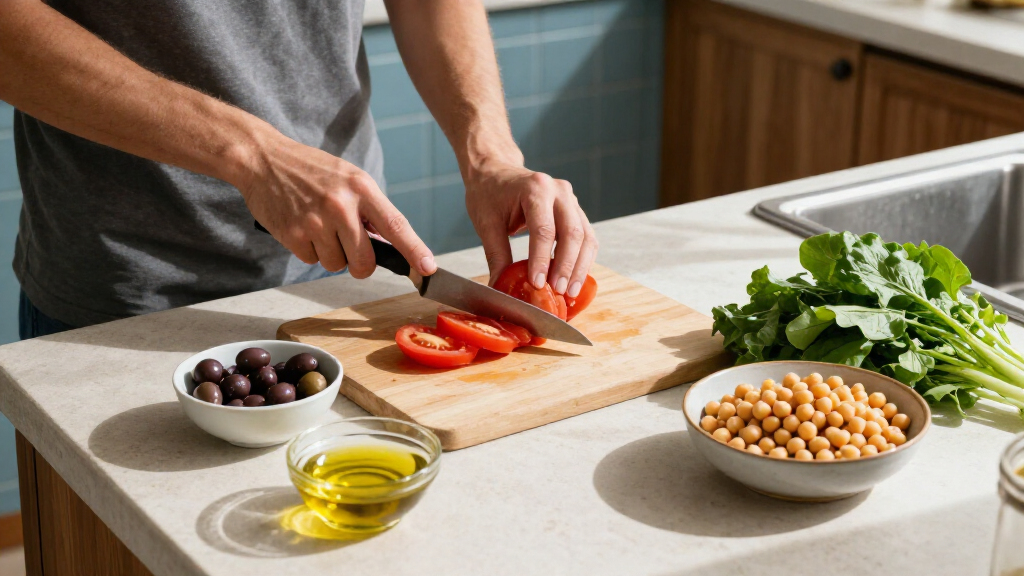
Some food associations differed by protein. Greater consumption of olive oil, fish, and legumes was linked to higher humanin levels. Olive oil consumption and lower intake of refined carbohydrates were associated with higher SHMOOSE levels. These are reported associations, not evidence that adding or removing a specific food will necessarily change either protein in an individual.
Diet Signals in Mitochondrial Proteins
The research offers a possible explanation for how an eating pattern associated with heart and metabolic health could relate to cellular processes involved in aging. Mitochondria are known for producing much of the energy cells use, but also participate in metabolism and stress responses. The study adds humanin and SHMOOSE to research examining whether mitochondrial signals may connect nutrition with those functions.
If further studies confirm the association, the proteins might help researchers measure how the body responds to dietary patterns. Senior author Pinchas Cohen said they could potentially serve as biomarkers of Mediterranean diet adherence and have clinical significance. That possibility remains preliminary: the report does not show that testing these proteins would improve care, predict an individual’s future health, or guide dietary treatment.
The distinction matters for readers because a biological association can help generate research questions without showing that a diet directly protects a person from heart disease or neurodegeneration. The reported study is not a clinical trial demonstrating disease prevention, and it does not establish that changing protein levels changes health outcomes.
extra virgin olive oil Mediterranean diet
As an affiliate, we earn on qualifying purchases.
As an affiliate, we earn on qualifying purchases.
What Humanin and SHMOOSE Do
The Mediterranean diet generally emphasizes olive oil, fish, legumes, fruits, and vegetables. It has been associated in prior research with lower risks of conditions including heart disease, type 2 diabetes, and cognitive decline. Scientists continue to investigate the mechanisms that may account for those associations; the present report describes one possible route rather than a complete explanation.
Humanin was identified in 2003 by Cohen and other researchers. Later studies have associated it with insulin sensitivity, cardiovascular health, longevity, and cognitive function. The supplied report describes these as areas of prior research, not as proven effects of raising humanin through food. SHMOOSE is a more recently identified mitochondrial microprotein. Researchers have reported a genetic variant associated with increased Alzheimer’s risk and possible protective activity of the normal version in relation to neuron damage involving amyloid.
Unlike most proteins, which are encoded by DNA in the cell nucleus, mitochondrial microproteins are produced from small genetic regions in mitochondrial DNA. Some regions once thought not to encode functional molecules are now being studied for that potential. The report also mentions a possible connection between humanin and Nox2, an enzyme involved in generating reactive oxygen species, but the supplied material ends before giving details of that finding.
“These peptides are emerging as key regulators of aging biology. They connect mitochondrial function to diseases like Alzheimer’s and heart disease and now, potentially, to nutrition.”
— Pinchas Cohen
Mediterranean diet cookbook for older adults
As an affiliate, we earn on qualifying purchases.
As an affiliate, we earn on qualifying purchases.
Cause and Health Effects Remain Open
The supplied report describes an observational comparison of older adults, so it cannot show that Mediterranean-style eating caused higher microprotein levels or lower oxidative-stress indicators. Other differences between participants could contribute to the results. The report does not provide enough methodological detail to assess the size or precision of the associations, including the sample size, duration, or adjustments for other factors.
It is also unclear whether the observed protein levels translate into meaningful changes in heart or brain outcomes. The findings do not show that humanin or SHMOOSE can be used as clinical tests, that manipulating them is safe or effective, or that particular foods will reliably raise them. The supplied source text cuts off during its discussion of Nox2, leaving that potential finding’s details unavailable.
legume variety pack beans lentils chickpeas
As an affiliate, we earn on qualifying purchases.
As an affiliate, we earn on qualifying purchases.
Further Studies Must Test the Link
Further research would need to establish whether the associations hold in larger and more diverse groups, and whether they persist over time. Studies that track dietary patterns alongside repeated measures of humanin, SHMOOSE, and oxidative stress could help clarify timing and consistency; controlled dietary research could better test whether changes in eating patterns cause changes in protein levels.
Researchers would also need to connect any protein changes with measurable health outcomes before the proteins could be considered useful clinical biomarkers or targets. The supplied report does not specify a planned follow-up study, publication details, or a timeline for additional results. For now, the finding adds a possible mechanism to ongoing research rather than changing established dietary or medical guidance.
Mediterranean diet meal planning guide
As an affiliate, we earn on qualifying purchases.
As an affiliate, we earn on qualifying purchases.
Key Questions
What did the study find?
Older adults who followed the Mediterranean diet more closely had higher blood concentrations of humanin and SHMOOSE and lower indicators of oxidative stress, according to the report.
Does this prove the diet protects the heart or brain?
No. The findings show an association, not proof that the diet caused protein changes or prevented heart disease, Alzheimer’s disease, or other conditions.
Which foods were linked with the proteins?
Olive oil, fish, and legumes were associated with higher humanin. Olive oil and lower refined-carbohydrate intake were associated with higher SHMOOSE. These reported links do not guarantee an individual response.
Could humanin and SHMOOSE become health tests?
The study’s senior author said the proteins could potentially serve as diet-adherence biomarkers. Their clinical usefulness has not been established in the supplied report.
Source: rss
Fall Picks
fall essentials
As an affiliate, we earn on qualifying purchases.