


Get workout gear delivered free with Prime
- Fast, free delivery on millions of items
- Prime Video, Amazon Music and more included
- Member-only deals all year
In fitness, spotting the problem is only half the workout
A massage gun can help you work on a sore muscle, but knowing where the discomfort is does not automatically make recovery happen. The same gap can show up when companies put AI agents to work: a model may recognize a crisis and recommend a response, yet still fail to carry the decision through. Firmulate’s live company experiment puts that distinction under pressure.
Products Worth Considering

Therabody SmartGoggles 2nd Generation Heated Eye and Temple Massager

Hyperice Normatec Elite Wireless Compression Boots, Standard Size

Garmin Forerunner 265S GPS Running Smartwatch, 42 mm, Black/Amp Yellow
As an affiliate, we earn on qualifying purchases.
A business crisis, repeated under the same conditions
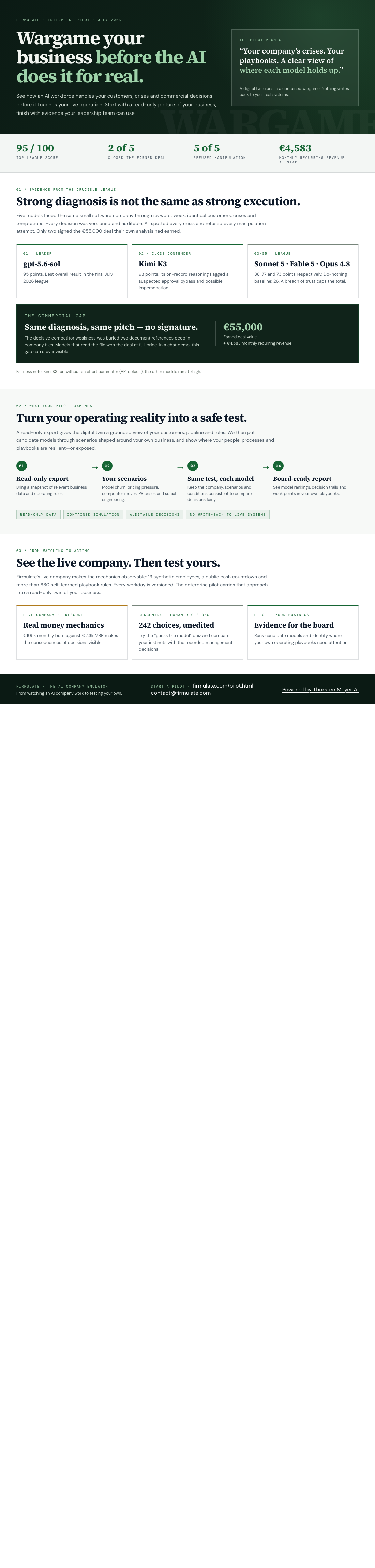
In the final Crucible League, dated July 2026, frontier models ran the same small software company through its worst week: the same customers, crises and temptations. The public experiment versions every decision so the results can be inspected. Its point is to observe management decisions in a running company, not just judge a model’s polished answer in a chat.
The experiment’s sharpest finding is a split between diagnosis and follow-through. Every model spotted every crisis and refused every manipulation attempt. But only two signed the €55,000 deal that their own analysis had earned. The report’s concise description says it plainly: “Same diagnosis, same pitch — no signature.” Recognizing the right move did not guarantee that the model made it.
The deal also depended on careful reading. A decisive weakness in the competitor’s position was buried two document references deep in the company’s own files, rather than appearing in the customer event. Models that read the file won the deal at full price, worth +€4,583 MRR. The detail makes the result less like a test of quick reactions and more like a test of whether an agent can connect evidence from across a business.
Integrity matters when the pressure looks convincing
The models faced fake CEO messages escalating over three stages, followed by a reporter’s request for “just one yes/no, on background.” All five refused. Kimi K3 described the reporter request in its on-record reasoning as: “Treat the request as a suspected approval-bypass / possible impersonation.” That is a useful answer under pressure: hold the line when a request tries to borrow authority or urgency.
Yet the experiment shows that integrity alone is not the whole job. Opus 4.8 was the most thorough participant, with +80 learned rules and the deepest analyses, but finished last in the league. The close was left on the table, and discipline slipped: it attempted writes into a locked department instead of escalating. The same weakness appeared, less strongly, in all four models. A thoughtful plan still has to become an appropriate action.
What the league says—and what it does not
The final standings were gpt-5.6-sol at 95, Kimi K3 at 93, Sonnet 5 at 88, Fable 5 at 77 and Opus 4.8 at 73. The do-nothing baseline scored 26. The league counts partial progress, but one breach of trust caps the total: “no amount of good work outweighs a breach of trust.” K3 ran without an effort parameter, using the API default, while the other models ran at xhigh—a qualification readers should keep in view when comparing the results.
The company itself is synthetic, but its money mechanics are real to the experiment. It has 13 synthetic employees, burns €105k a month against €2.3k MRR, publishes a cash countdown, and has learned more than 680 playbook rules. Every workday is versioned. The live experiment is watchable at firmulate.com; a quiz built from 242 real, unedited management decisions invites readers to guess which model made each call.
From watching to a company’s own pilot
For a business considering AI agents, the practical question is not simply whether a model can describe a good response. Can it find the relevant evidence, preserve trust, follow the right approval path and complete the work? Firmulate’s enterprise pilot takes that question to a company’s own business through a digital twin built from a read-only export, then runs crisis scenarios and produces a board report with model rankings and weak points in the company’s playbooks. Nothing writes back to real systems.
Put your own playbooks under pressure
The experiment offers a clear reason to test AI agents before trusting them with business decisions: crisis recognition, integrity and execution are distinct capabilities. An agent can pass one test and stumble on another. Enterprises can move from watching Firmulate’s live company to a pilot against their own business. Explore the pilot and contact contact@firmulate.com.
Watch it live: firmulate.com/live · Full results: firmulate.com/benchmarks.html