
TL;DR
Massage guns, also called percussive therapy devices, use rapid pulses against a muscle to provide self-applied massage. They may temporarily ease perceived tightness or improve range of motion for some athletes, but evidence for faster healing or reliable performance gains is limited. Start gently, keep the device moving, and follow with an active warm-up before training.
Your legs can feel like stiff ropes on the morning after hill repeats, even when you’re eager to train again. A massage gun may help you feel more comfortable, but a buzzing device cannot erase a hard workout or repair an injury on demand.

Get workout gear delivered free with Prime
- Fast, free delivery on millions of items
- Prime Video, Amazon Music and more included
- Member-only deals all year
Massage guns, also called percussive therapy devices, use rapid pulses against the body to provide a form of self-applied massage. In this article, you’ll learn what the evidence suggests, how to work one into a warm-up or post-training routine, what features matter when choosing a device, and which symptoms call for a clinician instead.
The most useful way to think about a massage gun is as a comfort and mobility tool. It may make movement feel easier for a while, but sleep, food, sensible training progress, and medical care when needed still do the heavier lifting.
Treat a massage gun as a comfort and mobility tool; evidence does not establish reliable strength, power, endurance, or tissue-healing gains.
Start on a low or moderate setting, use light pressure, keep the device moving, and follow the manufacturer’s instructions.
Before exercise, follow any massage-gun use with an active warm-up specific to your sport.
Avoid bones, joints, the neck, head, injured or swollen tissue, and any spot that causes pain, tingling, or numbness.
Ask a clinician about use if you have a condition affecting bleeding, sensation, circulation, pregnancy, or an implanted medical device.
What Massage Guns Can Do for Tight Muscles
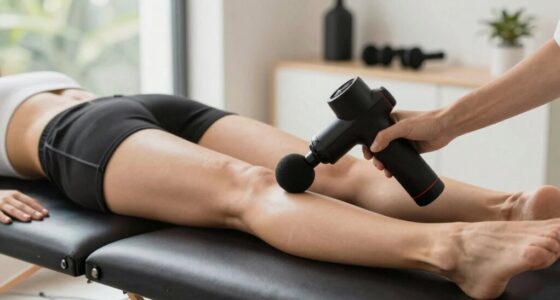
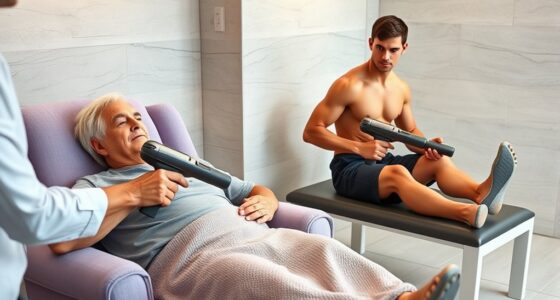
Massage guns for athletes can provide a brief, self-applied massage that may temporarily ease perceived tightness or improve range of motion. They send rapid pulses into a muscle, giving you a quick way to focus on a stiff spot before or after training. That short-term comfort can help you move more freely, though it does not show that an injury has healed.
Imagine stepping out of a long car ride before an evening basketball game. Your calves feel tight, and a gentle pass over the muscle might make a few ankle circles feel easier. Small studies suggest percussive therapy may temporarily increase range of motion or reduce perceived stiffness, but research remains limited and does not establish a reliable boost to strength, power, or endurance [1].
The distinction matters: feeling looser and being ready for hard exercise are not the same thing. Tightness is a sensation, not a reliable measure of tissue damage or readiness. If a brief pass makes a movement feel easier, that can be useful information about comfort; it cannot tell you that a muscle is ready for maximal effort. Follow with movements you’ll actually use, such as skipping, lunges, or easy sport-specific drills. An athlete with stiff hips could use a massage gun for comfort, then do walking lunges and controlled leg swings to prepare for a run.
Think of the device as a warm-up helper, not the warm-up itself. Your muscles still need active movement before you ask them to sprint, lift, or change direction.
According to the research summarized here, short-term mobility and perceived stiffness are more plausible benefits than improved performance or faster tissue repair [1]. That distinction helps set a useful boundary: a device may make a session feel more comfortable, but it should not be the reason you ignore pain, skip your warm-up, or increase your training load. Your response may differ from a teammate’s, so judge the tool by how comfortable it feels and whether it fits into a useful routine.
Products Worth Considering

Therabody JetBoots PRO Plus Wireless LED 3-in-1 Boots (30‑34 Inseam)

Garmin Forerunner 265S GPS Running Smartwatch, 42 mm, Light Pink/Powder Gray

BowFlex Results Series 552 SelectTech Adjustable Dumbbells (Pair)
As an affiliate, we earn on qualifying purchases.
Use a Massage Gun Before or After Training
You can use a massage gun before exercise for a brief comfort-focused pass, or after exercise if gentle massage helps you relax. Before a session, follow it with an active warm-up; afterward, avoid pressing aggressively into tissue that already hurts. The timing changes the purpose: before training, the goal is to feel comfortable moving, while after training it may simply feel soothing. Neither use needs to become a treatment session. Keep the device moving and follow its instructions.
- Choose a muscle, not a bone or joint. For example, target the fleshy part of your calf rather than the ankle. This keeps the pulses on compressible tissue and away from areas where direct pressure may be uncomfortable or risky.
- Start on a low or moderate setting. Test how it feels before increasing intensity. A stronger setting can feel more intense without making the benefit greater, so begin at the level that lets you stay relaxed.
- Glide over the muscle with light pressure. A practical starting point is a brief pass of about 30 seconds to a couple of minutes per muscle group, guided by the device instructions and your comfort. Moving across the muscle spreads the sensation; lingering on one spot can make it sore without giving you better feedback.
- Stop if you feel pain, numbness, tingling, or anything unpleasant. Those sensations are reasons to stop, not signs that the device is reaching a useful depth. More pressure is not a badge of honor.
- Before training, move actively. Follow with drills that match your sport, such as easy jogging and leg swings before a run. This checks how the muscle responds during movement and prepares you for the demands of the session.
Say you’re a recreational runner whose calves feel tight before a steady run. A short, comfortable pass might make walking feel easier; then start with a brisk walk and easy jog instead of heading straight into a fast interval. If the gun leaves the calf tender, skip it and warm up gently another way. The point is to begin training with movement that feels controlled, not to use the device to force a stiff muscle into readiness.
After a demanding strength session, a light pass may help some people feel more relaxed or make perceived soreness easier to manage [1]. It has not been shown to clear “lactic acid” or reliably speed muscle repair. That matters because feeling temporarily soothed can make it tempting to resume hard training before the underlying soreness has settled. Treat it as a possible comfort measure, not a recovery shortcut.
Keep the purpose simple: brief, gentle, and comfortable. If you find yourself pushing harder or staying on one spot longer to get the same effect, take that as a reason to pause and reassess rather than escalating the treatment.
What to Expect for Soreness and Recovery
A massage gun may make post-workout soreness feel more manageable for some people, but it is not a proven way to eliminate delayed-onset muscle soreness or accelerate muscle repair. Evidence for reduced perceived soreness exists, while claims about faster healing, restored performance, or clearing “lactic acid” have weaker support [1]. Feeling less sore is an experience, not proof that the muscle has recovered its capacity to handle another demanding session.
For example, after a new strength workout, your quads may feel tender when you sit down or take the stairs the next day. A gentle pass might feel soothing in the moment, much like light pressure from your hands, but it will not undo the training load. Your next steps still depend on how your body feels and what your training plan calls for. If your usual movements remain difficult or your strength feels reduced, temporary comfort from the device should not be used as a green light for maximal effort.
Recovery has several everyday ingredients: sleep, enough food and fluids, and a sensible training load. These support the body’s ability to adapt to exercise; a device can change how a tired area feels without replacing that adaptation. A device can sit alongside those habits if it feels good, but it should not crowd them out. If an athlete sleeps five hours and adds a hard session on painful legs, a gadget is unlikely to make that choice wise.
There is also an important difference between familiar post-exercise soreness and a possible injury. Soreness that gradually improves is not the same as sharp pain, marked swelling, weakness, or pain that worsens when you move. Those signs change the decision: instead of trying to massage through them, stop the activity that aggravates them and seek appropriate advice. Don’t use a massage gun to push through those signs.
Use it as a comfort option, not a recovery guarantee. If symptoms persist or interfere with ordinary activity, seek advice from a qualified professional rather than increasing the speed or pressure. A soothing sensation can be pleasant without telling you what caused the pain.
Choose Features That Make the Gun Easier to Use
The best massage gun for you is one you can handle comfortably and use according to its instructions. A quieter motor, lighter body, useful speed controls, and a comfortable grip may matter more day to day than extra modes or a flashy app. Product features can improve convenience, but they do not prove a device works better.
Picture packing for a weekend tournament. A heavy, noisy gun with a complicated menu may stay in your bag, while a compact device with a clear low setting is easy to reach after a long drive. On the other hand, a travel model with limited battery life may not suit someone who shares a device with a whole team. Comfort and ease of use are personal tradeoffs.
| Feature | Why you might care | What to check |
|---|---|---|
| Weight and grip | You need to reach a muscle without straining your hand. | Can you hold and guide it comfortably? |
| Noise | A quieter motor may feel less distracting at home or in a shared room. | Listen to it if you can; product claims vary. |
| Speed and stroke settings | Controls give you options for a gentler sensation. | Make sure the lowest setting feels comfortable. |
| Battery and warranty | Convenience and repair support can matter over time. | Check the stated battery life and warranty terms. |
These features involve practical tradeoffs. A smaller, lighter device is easier to carry and reach around your body, but may have less battery capacity. More settings can offer choice, but only help if the controls are clear enough that you can consistently select a comfortable level. Research often involves small groups, short follow-up, or devices that differ from consumer models [1], so a longer feature list should not be mistaken for evidence of better recovery.
Before you buy, try a few questions: Can you reach the muscles you want to target? Does the gentlest setting feel pleasant? Can you charge, carry, and clean the device easily? A straightforward model that fits your routine may be a better pick than a pricier one with features you never use.
Know When to Put the Device Away
Use a massage gun only on comfortable muscle tissue, and avoid areas where pressure could cause harm. Do not apply it directly over bones, joints, the front or side of the neck, the head, bruises, open wounds, infection, or significant swelling. Do not use it on a suspected fracture, acute muscle tear, blood clot, or unexplained painful condition. These limits matter because the device delivers repeated pressure without identifying what is underneath; an area that looks or feels injured needs assessment, not stronger percussion.
Consider a trail runner who twists an ankle, then notices swelling and sharp pain. Running a massage gun over the swollen area could worsen discomfort and delay a proper assessment. Rest from the painful activity and seek appropriate medical advice instead of treating the device as a home diagnostic tool. Even if the pulses briefly change the sensation, that would not establish that the ankle is safe to load.
Some health situations need extra care. If you have a bleeding disorder, reduced sensation, circulation problems, pregnancy-related concerns, or an implanted medical device, ask a clinician before using one. You may not feel pressure or heat normally, or your health circumstances may change what is safe. Professional guidance matters when your medical history affects sensation, circulation, or bleeding.
Stop and get medical assessment if you have severe or persistent pain, weakness, marked swelling, or symptoms that worsen. These signs can point to a problem a massage gun cannot evaluate, and delaying assessment to keep trying settings may make it harder to respond appropriately. A painful spot does not need more percussion to prove it is serious. For example, numbness after treatment is a clear signal to stop rather than changing attachments or switching to a faster setting.
Comfort is the limit. A massage gun should not cause sharp pain, tingling, numbness, or a feeling that you have to brace yourself against the pressure.
If a clinician has given you specific guidance for an injury or condition, follow that advice over a generic routine. The device is optional; getting the right help for persistent or unexplained symptoms is the priority.
Frequently Asked Questions
Do massage guns actually work?
They may temporarily improve range of motion or reduce perceived tightness and soreness for some people. Evidence for faster healing or dependable performance gains is limited, so judge the device by comfort rather than promises.
Should I use a massage gun before or after a workout?
Either may suit you. Before exercise, keep it brief and follow with an active warm-up; after training, use it gently if it feels soothing, and avoid aggressively treating painful or injured tissue.
How long should I use a massage gun on each muscle?
Start with a brief pass, often around 30 seconds to a couple of minutes per muscle group, and follow the device instructions. Longer or harder treatment is not automatically better; stop if you feel pain, numbness, or discomfort.
Can a massage gun help with DOMS?
It may make delayed-onset muscle soreness feel more manageable for some people, but it is not a proven way to eliminate DOMS or accelerate muscle repair. Rest, appropriate training adjustments, and time still matter.
Can a massage gun replace stretching or a sports massage?
A massage gun may complement your routine, but it does not replace an active warm-up, rehabilitation, or hands-on assessment when needed. If an injury is limiting movement, ask a qualified professional for guidance.
Where should I avoid using a massage gun?
Avoid bones, joints, the head, the front or side of the neck, bruises, open wounds, infection, significant swelling, and suspected injuries. Stop if treatment causes sharp pain, tingling, numbness, or worsening symptoms.
Are expensive massage guns better?
Not necessarily. Weight, grip, noise, battery life, warranty, and an easy-to-use gentle setting may matter more than extra modes or app features. Added features do not by themselves show that a model works better.
Conclusion
A massage gun can be a handy part of an athlete’s routine when it feels comfortable and helps movement feel less stiff. Keep passes brief and gentle, warm up actively before training, and leave painful or swollen areas alone.
Remember what the tool can offer: a little comfort, not a shortcut to recovery. Let it buzz softly across a tired calf, then let smart training and real rest do their work.